| 
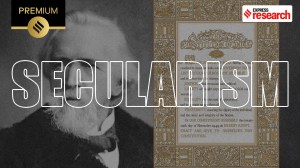
Dear reader, George Jacob Holyoake, a 19th-century British social reformer, hardly ever features in political discussions in India. Yet, a single word coined by him about 150 years ago has shaped the nexus between religion and politics across the world. We are talking about ‘secularism’, a word that Holyoake conceived while in jail, convicted for blasphemy. Holyoake was keen on finding an alternative to the English way of living in which religion dominated all aspects of life. The concept of atheism that he had first embraced, he realised, was often understood as a devilish ideal that rejected God. He spent a decade struggling to articulate a more acceptable idea, and finally came up with the term ‘secularism’. More than a hundred countries today affirm the philosophy of secularism. At the same time, the concept is increasingly being contested in many parts of the world. In India, recently, senior BJP leaders demanded the removal of the word ‘secular’ from the Preamble of the Constitution. Interestingly, its inclusion in the Constitution only happened in 1976, during the Emergency declared by Indira Gandhi. Many among the founding fathers of Indian democracy, such as Jawaharlal Nehru and B R Ambedkar, who were staunch believers in the doctrines of secularism, had decided not to include the word in the Constitution. However, as experts put it, India was always secular, with or without the word. Our story this week explores the story of ‘secularism’ from its very inception. We found that while the word itself was coined only in 1851, antecedents of the idea existed much earlier in several societies, including the Greek city states and ancient India. The word ‘secular’ traveled with colonialism in the 19th century, and everywhere it went, it came to be applied differently, in context of the cultural and historical circumstances existing in that particular region. In other news, Saif Ali Khan, the great-grandson of Hamidullah Khan, the last Nawab of Bhopal, is embroiled in a complex legal dispute with the Indian government. Several of his key assets, including the Flag Staff House and Noor-Us-Sabah Palace in Bhopal, have been designated as “enemy properties” because Abida Sultan, Hamidullah Khan’s eldest daughter, migrated to Pakistan. This lawsuit is among a growing number of cases in which claimants are seeking ownership of enemy properties. In this story, we unravel what the Enemy Property Act is, when it was enacted and how it originated. Wishing you a pleasant weekend ahead. Sincerely, Adrija Roychowdhury |





No comments:
Post a Comment