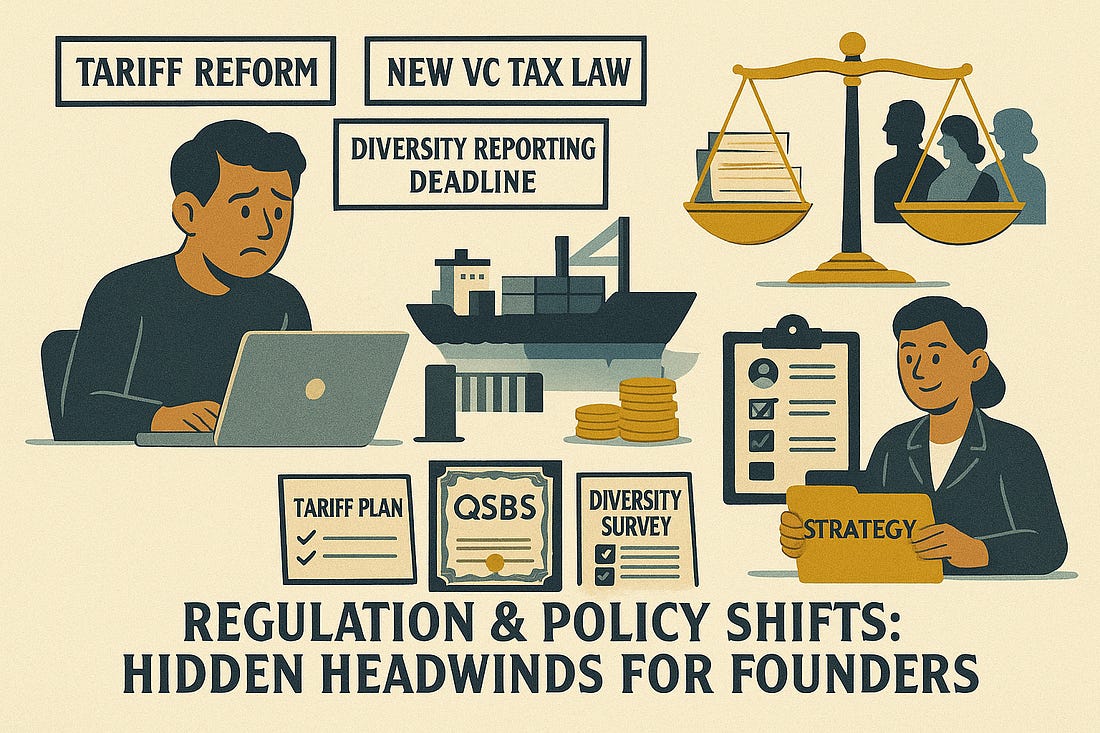
The VC landscape of 2025 isn’t just shaped by market cycles—it’s being rewritten by policy changes, new compliance mandates, and shifting investor priorities. For founders, staying ahead means more than building product-market fit; it means mastering the regulatory playbook.
In this issue, we dissect three policy shifts that are quietly—but fundamentally—reshaping how startups get built and funded.
Why are VCs grilling you on cross-border logistics?
The new reality: Recent U.S. tariff reforms are making investors more selective about the companies they back—especially those exposed to international supply chains. According to Deloitte, startups must now present robust tariff-mitigation strategies in their investor materials
Reference - deloitte.com.
What the numbers say:
84% of VC investors expect tariffs to have a “mild-to-moderate” impact on their portfolio companies in 2025 (PitchBook H1 2025 Tech Survey).
64% anticipate higher supply-chain costs due to ongoing trade tensions and compliance uncertainty
Reference - foley.com.
What to do:
Incorporate tariff-management strategies into your pitch deck:
Use bonded warehouses to delay duties.
Seek out free-trade agreements for sourcing key inputs.
Diversify suppliers to reduce risk.
Be proactive: Show how these strategies protect margins and de-risk the business—not just in procurement, but in go-to-market timelines and customer pricing.
The One Big Beautiful Bill (OBBBA): Permanent Tax Shifts for Startups
Major wins, if you know how to use them.
What’s changed:
The OBBBA, passed in July 2025, permanently extends the 20% qualified business income (QBI) deduction for pass-throughs and introduces two founder-friendly QSBS tweaks:
Holding period for QSBS tax exclusion drops from five years to three.
Exclusion percentage rises, allowing founders to shield more gains from federal taxes
Reference - ballardspahr.com
Interest deduction calculations revert to a more founder-favorable formula, increasing the headroom for leverage.
Reference - ballardspahr.com
Why it matters:
If structured right, early-stage founders can potentially exclude 100% of capital gains on up to $15 million per founder (or more, via stacking) after only three years, dramatically improving long-term returns.
How to act:
Cap table optimization: Structure equity grants and early investments to maximize QSBS eligibility—watch out for holding company traps and ensure stock is “original issuance.”
Legal review: Revisit company bylaws and shareholder agreements for QSBS compliance and interest deductibility.
Communicate to investors: Explain clearly how your structure unlocks tax-efficient exits. It can be a genuine differentiator in a risk-off environment.
Demographic reporting is here—and it’s expanding.
What’s new:
California’s updated law now requires all VC firms with significant business in the state (not just those headquartered there) to file anonymized demographic data on their portfolio’s founding teams.
Reference - clearyenforcementwatch.com.
Enforcement starts 1 March 2026—but collecting accurate data and building reporting workflows takes time
Reference - clearyenforcementwatch.com.
Who’s covered:
Any VC firm (or fund manager) that either has an office, raises money from California LPs, or invests in California companies.
Startups should expect VC partners to request voluntary, self-reported demographic data at the cap table and founder level.
Reference - clearyenforcementwatch.com.
How to prepare:
Build a voluntary, opt-in demographic data process: Make this part of your onboarding for all new hires and co-founders—use secure, privacy-compliant surveys.
Communicate transparently: Explain to your team why data is being collected (regulatory, not for investment bias).
Audit readiness: Ensure you can respond to VC partner and fund auditor requests for anonymized, aggregate-level data.
Add a “Tariff & Supply Chain Risk” slide to your next pitch deck (with 2-3 bullet points on how you mitigate headline risks).
Meet with your legal counsel this quarter to optimize QSBS eligibility for all founding shares and review interest deductibility.
Set up a privacy-compliant, opt-in demographic data collection process and have a founder or operations lead own this workflow—start now, not in 2026.
Observational Take:
“If you treat regulatory strategy as a last-minute checkbox, you’re behind. The best founders now treat tax and compliance as tools to enhance their valuation story, not just risks to manage.”
The founders who win in 2025–2026 will be those who treat regulatory acumen as a source of competitive advantage. Investors are watching.
Is your company ready for this new reality?
See you in the next issue,
– Shubham Bopche
Host, Venture Unlocked






No comments:
Post a Comment