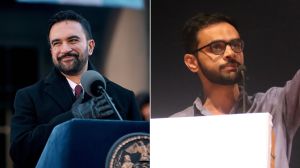
| Dear Reader, If you looked at news that came in over the last month, or news that is in the paper today, you would be overtaken by a sense of bleakness. As the old year yields to the new, it would seem that hate flourishes, unchecked, and BJP-led governments’ many abdications grow. At the same time, to the naked eye, it would also seem that the Opposition has a rousing agenda that is campaign ready. First, the news that is so dispiriting. In December, a young man from Tripura in the Northeast became the victim of a lethal hate attack in Dehradun, the city where he was studying, and no senior member of the BJP government or party called the crime by its name. Leading up to Christmas, attacks on churches and congregations, across states, by goons alleging conversion, were met with a similar silence. In Chhattisgarh, which has emerged as a ground zero for anti-Christian violence, the climate of impunity was underlined when six Bajrang Dal members arrested for vandalising Christmas decorations at a Raipur mall were welcomed with garlands, chants and a procession, after they were granted bail. A young woman’s birthday party in a Bareilly cafe was disrupted by vigilantes who objected to two of her guests being Muslim. In Indore, which wins awards for being India’s cleanest city, year after year, the contamination of drinking water has claimed lives and a senior BJP minister callously swatted down a reporter’s question on the need for accountability, and later apologised weakly. Local body elections in Maharashtra, India’s most urbanised state — which not long ago witnessed the most brazen tod phod (breaking up) of parties — have descended into a never-before free-for-all, with unlikely alliances and unabashed political promiscuity. What is more, 68 candidates of the ruling BJP-Shinde Sena Mahayuti, across the state’s municipal corporations, are being elected unopposed. In Delhi, the Modi government rushed through a bill in Parliament, which radically weakens MGREGA’s assurance to the poorest — rolling back its decentralised functioning and handing Delhi the power to decide on funds and works. Ahead of Umar Khalid’s bail plea coming up in the Supreme Court, when the CJI spoke of the importance of “empathy” in bending the “arc of justice towards the communities that need it most”, it only underlined the lack of it so far in the justice establishment. All too often, the judiciary appears to give the elected government the benefit of doubt, or takes its cue from it, which has contributed to a young scholar spending more than five years in jail, charges still not framed, a trial far from its beginning. These are separate distortions and transgressions but they rest on a bed of entangled themes — the vigilante is empowered, governance resists accountability, law is used to bend the rule of law, democracy is undermined using the tool-kit of democracy. And yet, take a look at the Congress-led Opposition, and whatever its fighting words, you see the same bewilderment and helplessness. Bewilderment, about why the BJP continues to win elections. Helplessness, on how to counter it. If it does not want to get lost in the dead ends and nihilistic politics of “vote chori”, the Congress-led Opposition needs to pause and ask itself why, despite the BJP government’s several failures and abdications, on the ground, its Constitution/democracy-in-danger argument is not striking sparks, except in sections of Dalits and among Muslims — two communities that depend on constitutional protections most crucially. Perhaps it needs to ask if its defence of constitutional values comes at a time when those very values are seen as fraying and besieged, not without the current Opposition’s, and earlier governments’, complicities. In India, as in other countries, settled values and frameworks of legitimacy are seen as bending under the weight of their own contradictions and conflicts of interest. In an era of communicative abundance, they are coming under pressure from the 24x7 performativeness of politics, and its new strategies of continuous mobilisation, which are changing the notion of political representation as we know it. In a time like this, the BJP has been quick to seize its opening — it portrays itself as the authentic carrier of the “voice of the people”, which needs to be unshackled and retrieved from the debris of the old order. In a time of turmoil and uncertainty, it projects emotive wholes and unities that create selfie points and comfort zones and invite “the people” in — be it “Hindu rashtra” or “patriotic India”, “Viksit Bharat” or “Vishwaguru”, or “De-Macaulayised/Decolonised India”. Of course, the BJP’s wholes and unities are not just about belonging, they rest on the fundamental — and continuing — exclusion of the Muslim minority. And they harness their emotional appeal to evade and resist calls for governmental accountability. But an Opposition that does not seem to even recognise the deeper crisis that underlies the BJP’s rise, is still unable to find the language to counter it. To do that, it would need to find the imagination and conviction and patience to repurpose the BJP’s whole — to reframe Hinduism by reinstating its pluralism, for instance, instead of getting spooked by it, and ceding more ground to the BJP. Or, it may need to frame a new imagined community that can invite all the people in. Prashant Kishor may have flopped in Bihar, but his pitch to voters, simple and powerful — “vote for your child’s future” — sought to straddle cleavages of caste and community, and offers something to work with. But for now, as the old year dissolves into the new, an Opposition stuck with an older vocabulary, which unsees the deeper crisis, can call out neither the BJP government’s abdications, nor the BJP project’s exclusions and silences. Till next week, Vandita Recommended Readings: |




No comments:
Post a Comment