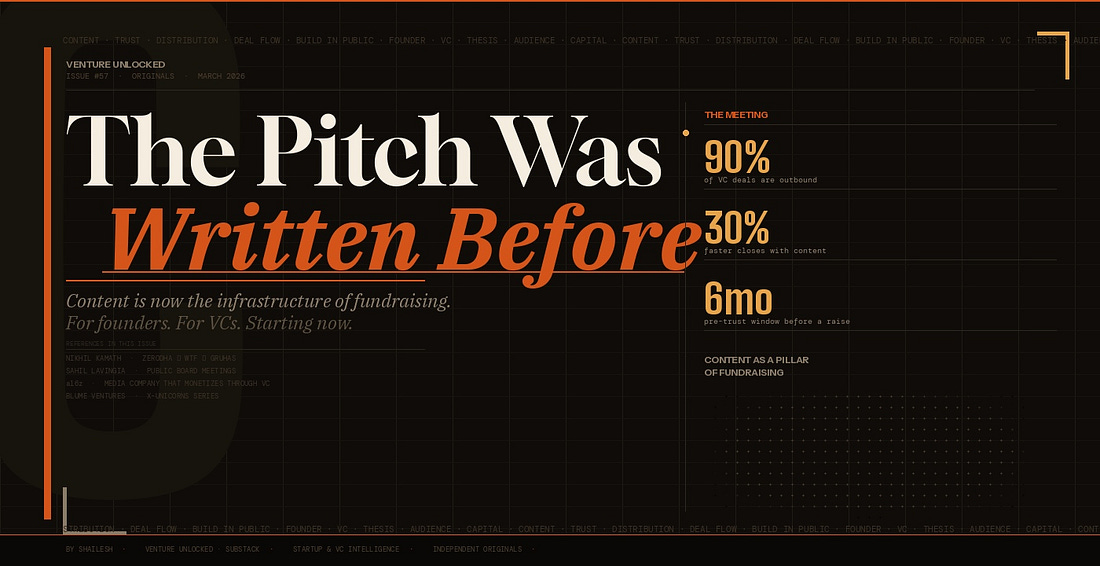
The Pitch Was Written Before the MeetingIssue 57 : Content is now a fundraising infrastructure for founders and VCs alike. This issue breaks down exactly how, and what you should do differently starting Monday.
The day a LinkedIn post did the work of a pitch deckIn early 2024, a Gurugram-based founder named Yashish Jain did something most founders would never dare. He opened his phone, typed out a post about his startup Bonomi, and told the internet he was raising a seed round. No deck attached. No warm intro chain. No 6-month grind through accelerator networks. Just a post. A number. A story. Within weeks, his round was nearly closed with just 5% of the funding left to fill. Investors had found him. Not the other way around. This is not a lucky story. This is a signal. Something fundamental has shifted in how trust travels between founders and investors. And if you haven’t noticed it yet, this issue is going to make you feel the urgency of that quite fast.
The Old WorldFirst, let’s be honest about what fundraising used to look likeIf you raised money 5–7 years ago in India, you know the ritual. You needed someone from IIM-A or BITS or IIT who knew someone who knew a partner at a fund. You needed a warm intro. You needed to be in the right WhatsApp group, or show up at the right Blume event, or get invited to the right dinner in Koramangala. The pitch deck was everything. Twenty slides had to carry the entire weight of your credibility, your market, your traction, your team, your vision. And even if you got in the room, the VC was meeting you for the first time. You had 45 minutes to build trust that their best-sourced deals had built over months. Cold emails went to graveyard inboxes. The system rewarded access over ability. And a lot of genuinely good founders got filtered out before they ever made it to a first meeting not because their company wasn’t good, but because no one had heard of them. It was an information problem dressed up as a funding problem. The ShiftSomething changed And it changed fast.
This is not a small number. It means investors are not sitting around waiting for cold pitches. They are actively looking for founders whose thinking they’ve been following people whose posts they’ve read at 11pm, whose threads they’ve forwarded to their partners. The deal starts way before the first meeting. It starts on LinkedIn, On X, On a podcast. In a newsletter thread. Content did something no warm intro network could it made founder credibility portable and scalable. You don’t need to be in the room to be known. You just need to be present, consistently, where your audience already is. This is what we mean when we say content is now a pillar of fundraising. Not a nice-to-have. Not personal branding fluff. A structural lever that compresses months of trust-building into weeks. Think of it as relationship compression. Before you send a cold email to a VC, they’ve already seen you think 20 times on LinkedIn. India StoryThe founder who built trust before he ever needed itMost people know Nikhil Kamath as the co-founder of Zerodha, India’s largest retail brokerage, built without a single rupee of VC money. But Zerodha alone doesn’t explain why Nikhil became one of the most watched voices in India’s startup and investing world. That happened through WTF Is his podcast. He didn’t launch it to market Zerodha. He launched it because he was genuinely curious about startups, about money, about why people make the decisions they make. He put top Indian VCs in a room Karthik Reddy of Blume, Prashanth Prakash of Accel, Rajan Anandan of Peak XV and asked them questions that most founders were too scared to ask publicly.
The podcast became school. For founders, for investors, for anyone trying to understand how the Indian ecosystem actually works versus how it’s supposed to work on paper. And then something interesting happened. Nikhil took all that credibility that audience trust he’d built over years of honest, curious content and converted it into investor trust when he launched Gruhas, his VC fund. Founders wanted to be backed by him. LPs wanted to be in his fund. Not because he had the best track record on paper, but because they already felt they knew him. Content compressed the trust cycle. Years of podcasting did what no pitch deck could do alone. Global StoryThe essay that rebuilt a fundraise from scratchCase: Sahil Lavingia / Gumroad
Years later, when Gumroad ran a public crowdfunding round, the audience was already there. People who’d read the essay, followed his build-in-public posts, watched his public board meetings on YouTube they didn’t need convincing. They converted. Sahil later documented the entire Gumroad journey on YouTube as public board meetings 8+ hours of footage covering numbers, product decisions, and lessons. His stated goal was to eventually have enough content to rival a semester-long college class. What he was really doing was building a proof of judgment in public, over time, at no cost. By the time he needed capital, the capital was already watching. The VC SideVCs figured this out too and some are playing it better than anyoneIn India, Blume Ventures quietly built one of the most consistent VC content operations around. The Blume Podcast, the X-Unicorns series these weren’t marketing exercises. They were a systematic way of showing founders what Blume actually believed, how they thought about risk, and what kind of companies excited them at the earliest stage. Karthik Reddy appearing on podcasts, writing about portfolio journeys, talking publicly about how Blume evolved all of it served one purpose: when a founder is deciding between three term sheets, the one from the VC they feel they already know wins disproportionately. Content, for a VC, is not about impressions. It is about getting into a founder’s consideration set before the pitch process even begins.
Now scale this idea to its most extreme version: a16z. Andreessen Horowitz is, by most honest accounts, better described as a media company that monetizes through venture capital. Their New Media team was built with one explicit goal winning the timeline of the founders they want to invest in. Hundreds of podcast episodes. Newsletters across every sector. Essays, threads, video. They recently formalized what they call a “timeline takeover” helping portfolio founders win the internet for a day when they launch. It’s a full media blitz: video, podcast, essays, coordinated social. And it’s offered as a value-add to founders, not an add-on service. Their own writing makes the point plainly: if a16z’s content consistently provides value to founders, those founders will feel aligned with the firm before they ever pitch. The deal starts in the content feed, not the pitch room. Benedict Evans, their former in-house analyst, put it even more directly: a16z is a media company that monetizes through VC. That’s not an accident. It’s a deliberate bet that in a world with too much capital, attention and trust are the real scarce resources. The Flip SideContent debt : the thing nobody talks about
When you walk into a room with no LinkedIn presence, no writing, no podcast appearances, no public point of view the VC has nothing to reference. They have to form a complete opinion of you in one meeting. That is a hard task for them and an even harder task for you. Meanwhile, the founder who’s been consistently posting for six months has already done that work. Every time a VC read their take on a market trend, a product decision, a team lesson they were quietly building the mental file that makes a yes easier to arrive at. Content debt gets harder to make up the longer you wait. And in a market where 90% of deals are outbound where VCs are sourcing founders they already know an empty profile is not neutral. It is a disadvantage. The founder in the meeting with the great deck and no online presence is competing against the founder whose deck a VC already half-believed before they opened it. The Behaviour ChangeFor Gen Z founders, this is now a ritual : not a tacticSomething shifted in the last two years that’s worth naming clearly. Younger founders - the ones building today treat content as a natural part of the fundraising lifecycle. Not a PR play. Not something they’ll “get around to.” It’s built into the rhythm of how they build. Before a raise: they post to signal momentum, build a point of view, and attract inbound interest. The podcast appearance before a round is the new version of “talking to your network.” It works at a scale no network can match. During a raise: their public presence answers questions investors haven’t asked yet. An investor who spends 10 minutes on a founder’s LinkedIn before a meeting already knows what that founder cares about, how they think, what they’ve shipped, and what they’re willing to be honest about. After a raise: the content keeps going. Because the next round starts the day the current one closes. And the customers watching are as valuable as the investors. This is the loop. Content → pre-trust → easier raise → content about the raise → next raise. It compounds. Every post builds on the last one. Every appearance adds to the stack. The founders who understand this aren’t posting for vanity metrics. They’re building infrastructure. What To Actually DoThree playbooks : one for each of youStrategic Playbooks
We keep treating content like a marketing function something you do after the real work is done. But the founders and investors building the most interesting things today know something different. Content is the work. It’s how you clarify your own thinking. It’s how you find the people who get it before you ever introduce yourself. It’s how trust gets built at a distance, over time, without a single meeting needed. The pitch was written before the meeting. In your posts. In your podcast appearances. In the essays you almost didn’t publish because they felt too honest. The question isn’t whether to build that presence. It’s whether you want to build it before the fundraise or explain its absence during one. Shubham Bopche - Editor Venture Unlocked is free today. But if you enjoyed this post, you can tell Venture Unlocked that their writing is valuable by pledging a future subscription. You won't be charged unless they enable payments.
|

Monday, 30 March 2026
The Pitch Was Written Before the Meeting





Subscribe to:
Post Comments (Atom)
No comments:
Post a Comment