

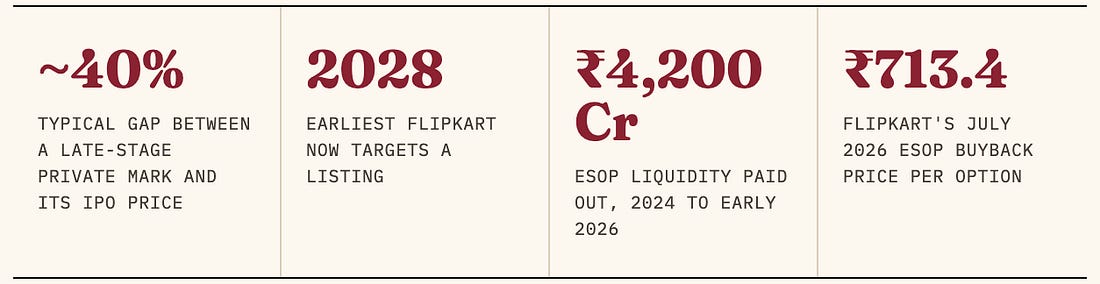
Flipkart is not going to list until at least 2028. Walmart has told it to reach EBITDA breakeven in FY27 first. And yet, in August 2026, Flipkart employees are cashing out shares at ₹713.4 each, a mark that puts the company at roughly $38.2 billion, about 6% above the $36 billion it last raised at in May 2024. Read that again. The listing is years away, the company is optimising for profit rather than growth, and the people who hold its equity are still getting liquid at a rising valuation. The money to pay them did not come from a stock exchange. It came from inside.
This is now the defining feature of late-stage private capital in India. When the public market is either shut or unflattering, companies do not simply wait. They manufacture liquidity from the cap table they already have, through insider rounds, pre-IPO rounds, secondaries and ESOP buybacks. The trend is easy to describe. The useful skill is reading each individual round for what it actually says about the company. That is what this issue teaches.
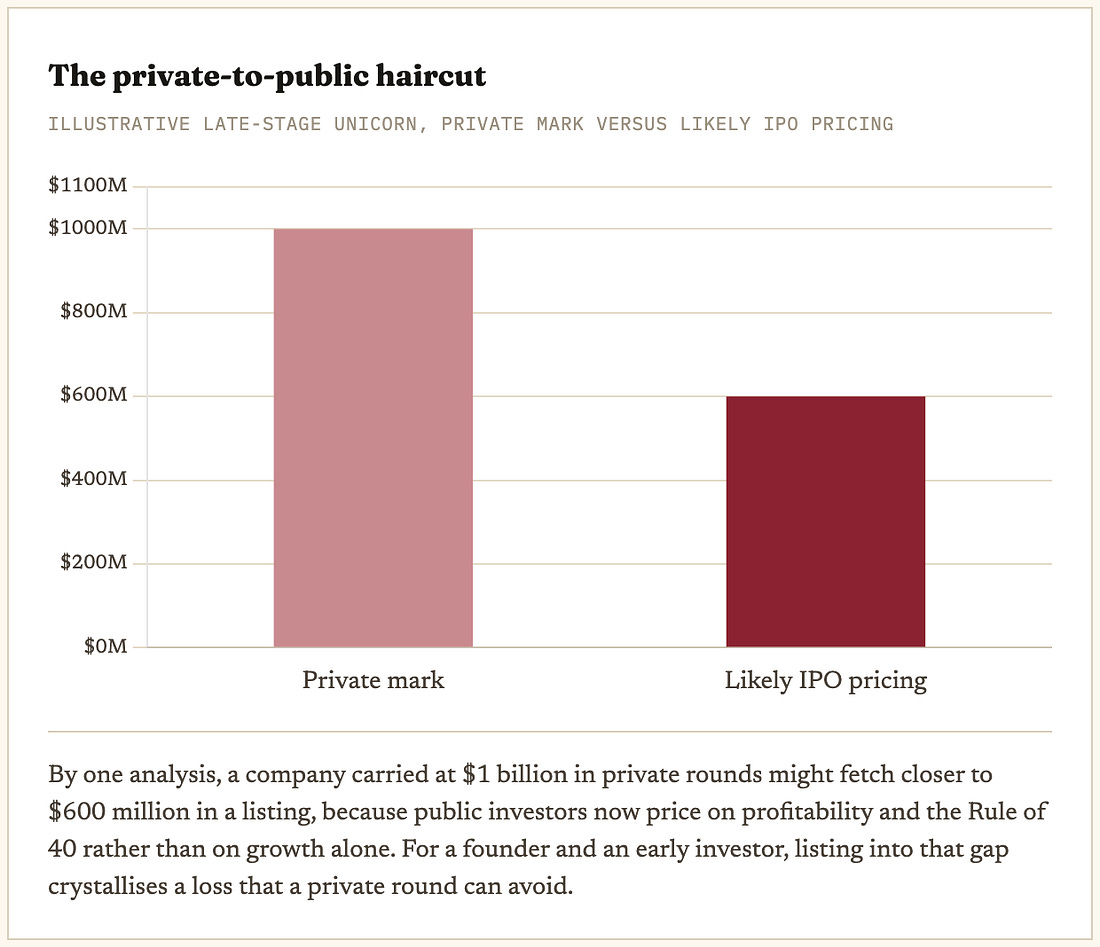
Section OneWhy anyone stays private and pays anywayThe whole behaviour rests on one number. The gap between what a late-stage company is worth on paper and what the public market will actually pay for it has widened to the point where listing becomes a decision to accept a markdown.
So the incentive is obvious. If listing means accepting a lower number, and if you can raise what you need from investors who are already on your cap table and motivated to protect their earlier entry, you raise from them. You keep the paper mark intact, you keep your employees whole, and you wait for the public window to improve. Two things made this easier in the last eighteen months, and one of them has gone almost entirely unremarked.
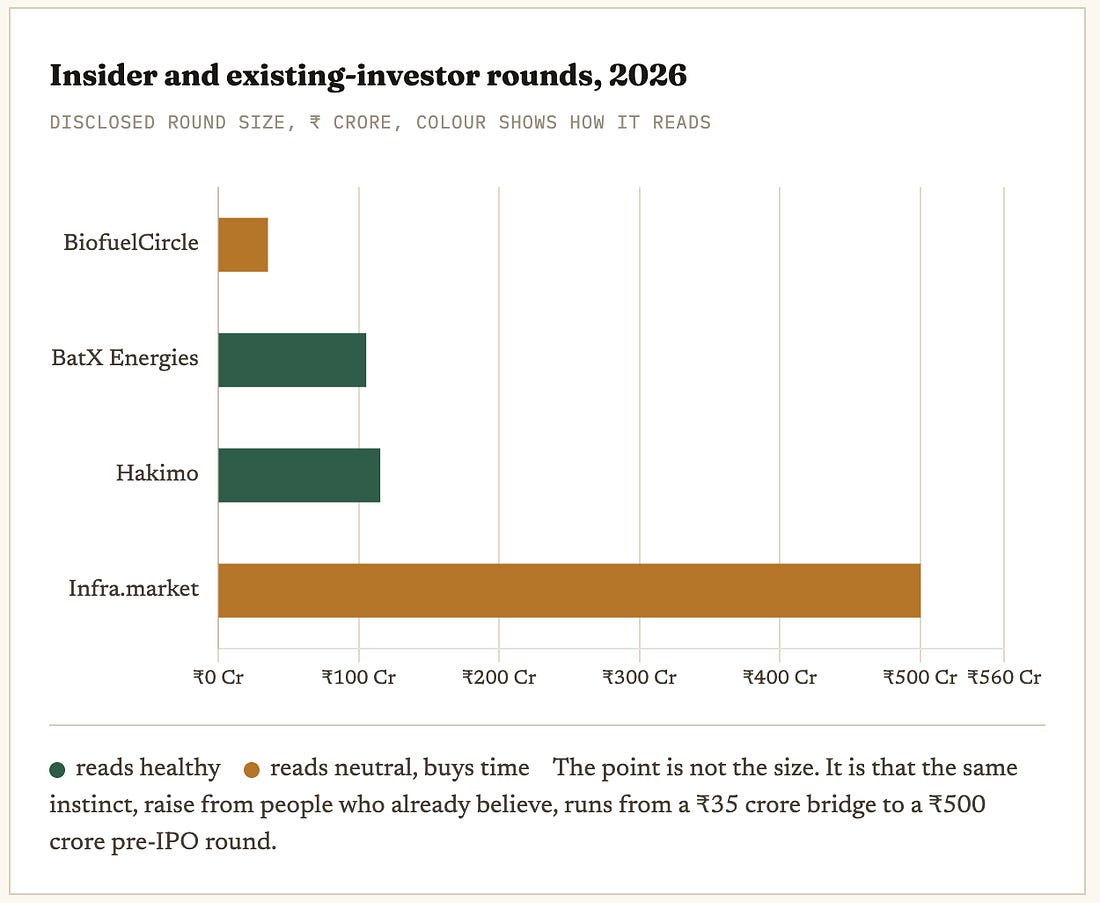
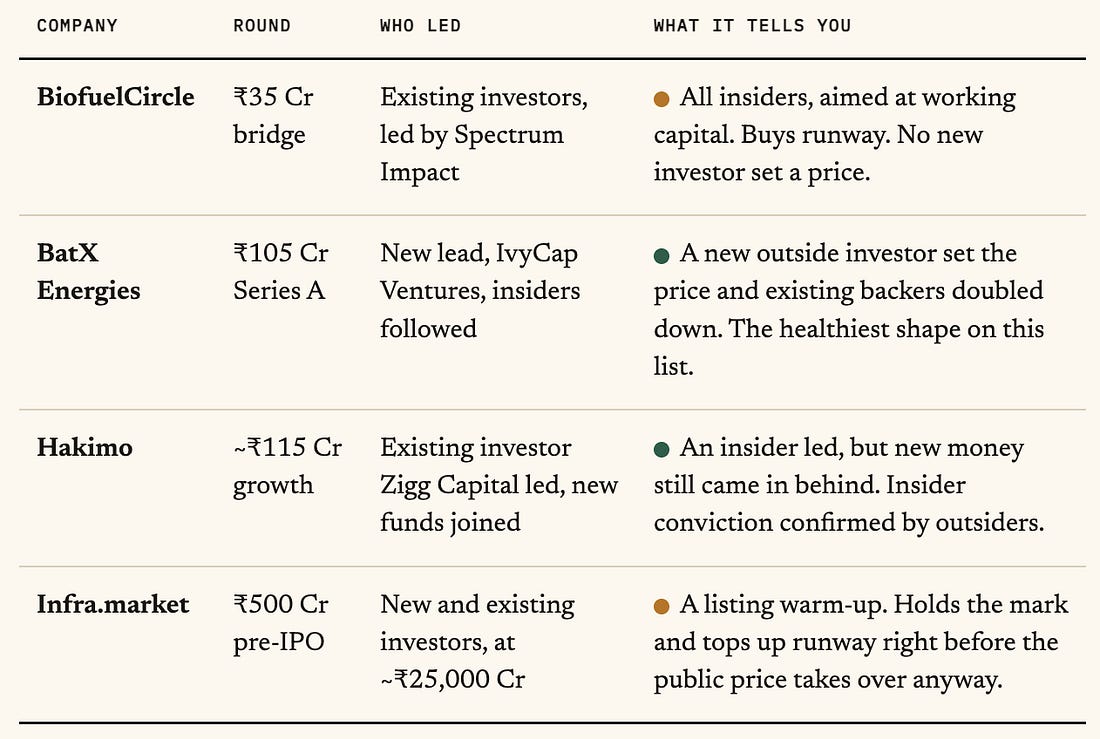
Section TwoThe same move, at five different sizesInsider rounds are not one thing. In 2026 alone, Indian companies have used the cap table for liquidity at every scale, from a working capital top-up to a listing warm-up. Laid side by side, they form a ladder.
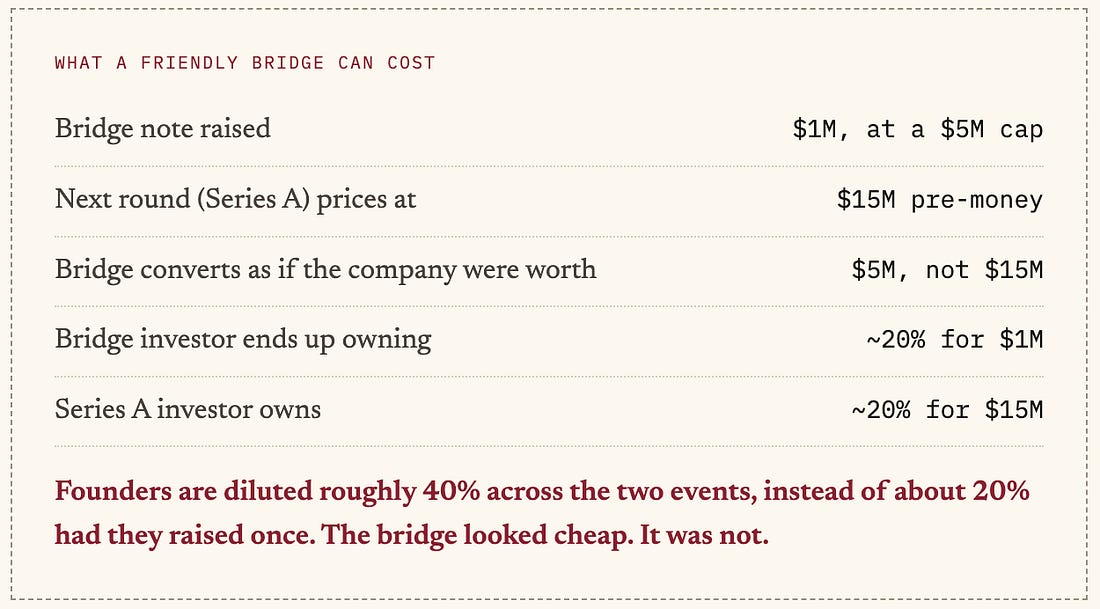
Flipkart sits above the whole ladder. It reportedly explored a $2 billion to $2.5 billion pre-IPO round before deferring its listing, and it is running its ESOP buyback in parallel. Same instinct, an order of magnitude larger. Notice what is missing from the table. There is no red dot. That is not because bad insider rounds do not exist. It is because they rarely get announced. Section ThreeThe mechanism does the hidingThe reason an insider round can hold a valuation is that, very often, it never sets one. Most bridges are not priced equity. They are convertible instruments.
That postponement is exactly why the instrument is popular, and exactly why it can obscure the real economics. A cap set generously in a bridge can cost founders far more than the headline suggests once the next round finally prices.
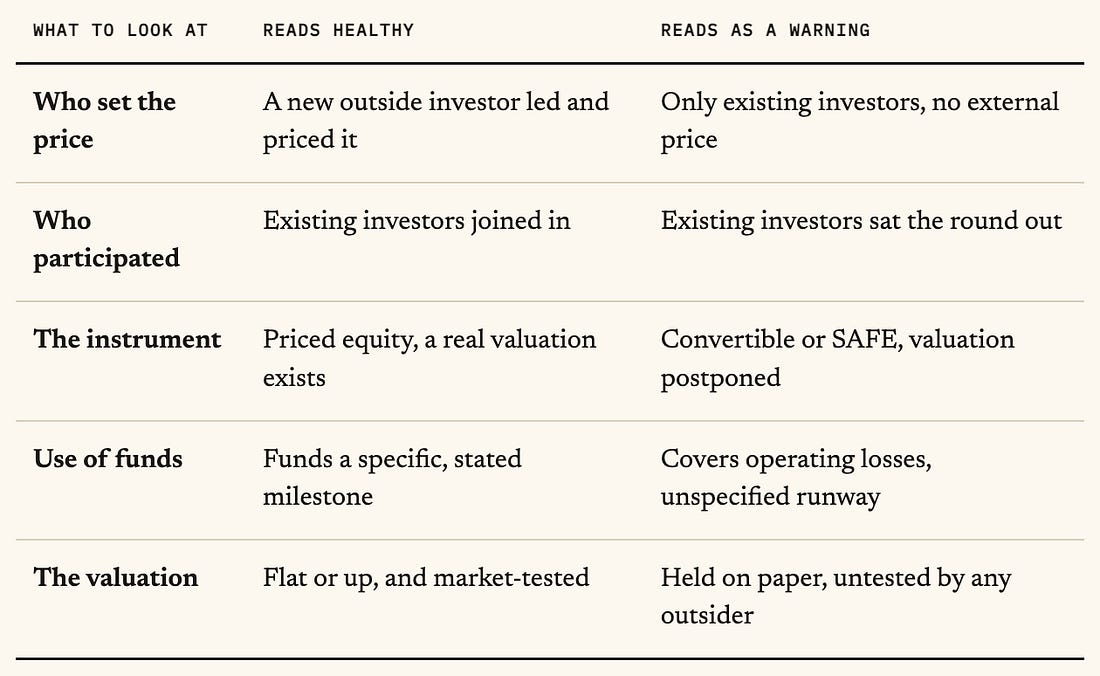
This is the heart of the reader’s problem. A priced round announces a number you can judge. A convertible round announces a headline amount and hides the number that matters. So the way to read an insider round is not to look at the size. It is to work out whether anyone actually set a price, and who agreed to it. Section FourHow to read the round in two minutes Five questions. You can answer most of them from the funding announcement itself, before you ever see a cap table.
Run the ladder back through this. BatX scores clean on every line, a new lead, a real price, insiders following. Hakimo passes because new money came in behind the insider lead. BiofuelCircle is not a warning, but it is a hold, insiders only, working capital, no fresh external price, which is precisely why it reads amber rather than green. The single most important line is the first one. A valuation only means something once someone with no prior stake agrees to it. Everything else is a company, and its existing believers, agreeing with themselves. Our readThe absence of red dots on that ladder is the whole story. When insiders refuse to fund a company, the round does not happen, so it does not get a press release. What you read in the funding roundups is a survivor list. Every insider round you can see cleared the lowest bar, which is that the people closest to the company were willing to put in more. That makes the visible signal weaker than it looks, and the invisible signal much stronger. The companies quietly not raising insider rounds this year are telling you something louder than the ones that are. You just have to notice the silence. Which turns the ESOP buyback into the most honest signal of the lot. A company can hold a paper mark in an insider round without anyone testing it. But when it writes real cheques to employees at that mark, as Flipkart just did at ₹713.4, it is putting cash behind the number. That is not proof the valuation is right. It is proof the company believes it enough to spend on it. Last issue we looked at companies that reached the exit door and turned back, and we ended on a test, when a company files to list, watch how much the insiders are selling. This issue is the stage before that. When a company raises without listing at all, watch whether any outsider agreed to the price. Meesho shows both tests meeting. When it finally listed, its early backers behaved very differently from one another. Elevation sold just over 4% of its stake, Peak XV around 3%, Y Combinator trimmed roughly 14%, while SoftBank, Prosus and Fidelity sold nothing at all, and the offer for sale was cut about 40% from the draft. The private-market signal and the public-market signal are the same signal, read at two different doors.
A note on the numbersFlipkart’s implied valuation of about $38.2 billion is derived from the ESOP buyback price and adjusted for its Singapore-to-India redomicile, and its explored pre-IPO round was reported but not confirmed as closed. The $1 billion to $600 million haircut is an illustrative figure drawn from published private-to-public valuation analysis, not a specific company. Round sizes are as disclosed at the time of announcement and convertible conversions vary with the terms of each note. Verify every figure at source before quoting. Thanks for reading. If a founder you know is about to call an insider round a vote of confidence, send them the two minute test first. Shubham Bopche - Editor Venture Unlocked is free today. But if you enjoyed this post, you can tell Venture Unlocked that their writing is valuable by pledging a future subscription. You won't be charged unless they enable payments.
|






No comments:
Post a Comment